4-24-26: RE: Formal Opposition to Proposed Tulane University Student Housing Development at S. Claiborne Avenue, S. Miro Street, and Calhoun Street
April 27, 2026
New Orleans City Council
1300 Perdido Street
New Orleans, Louisiana 70112
Tulane University Board of Administrators
Office of the President
6823 St. Charles Avenue
New Orleans, Louisiana 70118
RE: Formal Opposition to Proposed Tulane University Student Housing Development at S. Claiborne Avenue, S. Miro Street, and Calhoun Street
Dear City Council Members and Tulane University Officials:
Louisiana Landmarks Society writes to formally oppose the proposed development of apartment-style student housing at the corner of S. Claiborne Avenue, S. Miro Street, and Calhoun Street. This project, announced via press release on March 23, 2026, and slated to open in Fall 2027, raises serious concerns across six distinct areas: community engagement and transparency; scale, massing, density, and neighborhood character; institutional overreach; parking, traffic, and quality of life; pedestrian safety along a major U.S. highway; and the threatened destruction of a beloved neighborhood cultural landmark. We respectfully request that this project be halted; subjected to rigorous independent review; and reconsidered through a genuine and inclusive community engagement process.
I. Failure of Community Engagement and Transparency
Perhaps the most troubling aspect of this proposal is the way it was introduced. The community, including those directly impacted such as the Versailles Boulevard neighborhood, first learned of this significant development not through direct outreach, community meeting, or a town hall — but through a Tulane University press release. That is wholly unacceptable for a project of this magnitude.
The community was told that the developers had been bound by a Non-Disclosure Agreement with Tulane and therefore could not speak of the matter. This means that while community stakeholders were kept in the dark, planning, the purchase of land, and binding agreements were quietly advancing. At the neighborhood meeting held on April 6, 2026, developers again invoked the NDA when asked to describe the terms of their arrangement with Tulane.
That silence is not neutral — it is revealing. The next logical question is what that silence conceals: specifically, whether the university intends to operate the facility temporarily and then abandon the arrangement; or whether it plans eventually to purchase the property outright, expanding its campus across S. Claiborne Avenue and removing the site from the property tax rolls — all without any public process or engagement.
Tulane's own residential policies compound these concerns. The university requires all freshmen, sophomores, and juniors to live on campus — and the developers have explicitly stated that this development will not be part of the campus. But at the April 6 meeting, Tulane representatives refused to confirm that undergraduates will be restricted. This is a direct contradiction to their dormitory requirements. The community is entitled to a clear, binding, and publicly stated answer as to how this project fits within Tulane's residential requirements and long-term institutional plans. At that same meeting, the developers represented that the project is a "done deal” – seeming to eliminate the City Council's and the community's ability to have a say in the matter.
Misrepresentations extended to discussions at the Historic District Landmarks Commission (HDLC). At the April 8, 2026, hearing, the developers argued that the HDLC’s denial of the 3100 Calhoun demolition request contradicted the Commission’s own standards — asserting that because the building is rated non-contributing, its demolition should be automatically approved. This argument fundamentally misunderstands — or deliberately misrepresents — the purpose of Commission review. Each site must be evaluated on the merits of its individual circumstances. If the demolition of all non-contributing buildings were automatically approved, there would be no reason for Commission review in the first place. The Commission’s role is precisely to weigh unique circumstances, and its ruling should be respected accordingly.
We call on Tulane University and RCR Claiborne Venture III, LLC, to commit to a transparent, open, and good-faith community engagement process — one in which neighborhood residents are treated as partners rather than afterthoughts.
II. Incompatible Scale, Massing, Density, and Neighborhood Character
The proposed development would house 160 students in 39 units — grossly out of sync with the surrounding neighborhood. Much of the area is zoned HU-RS, which the City’s Comprehensive Zoning Ordinance describes as intended “to provide for [traditional] single-family residential development” (CZO Art. 11.1.A). The HU-RS neighborhood consists almost entirely of one- and two-story single-family residences that define the architectural fabric and social character of this historic community. A multi-unit, block-style, unappealing apartment building of this density would be starkly incompatible with that character.
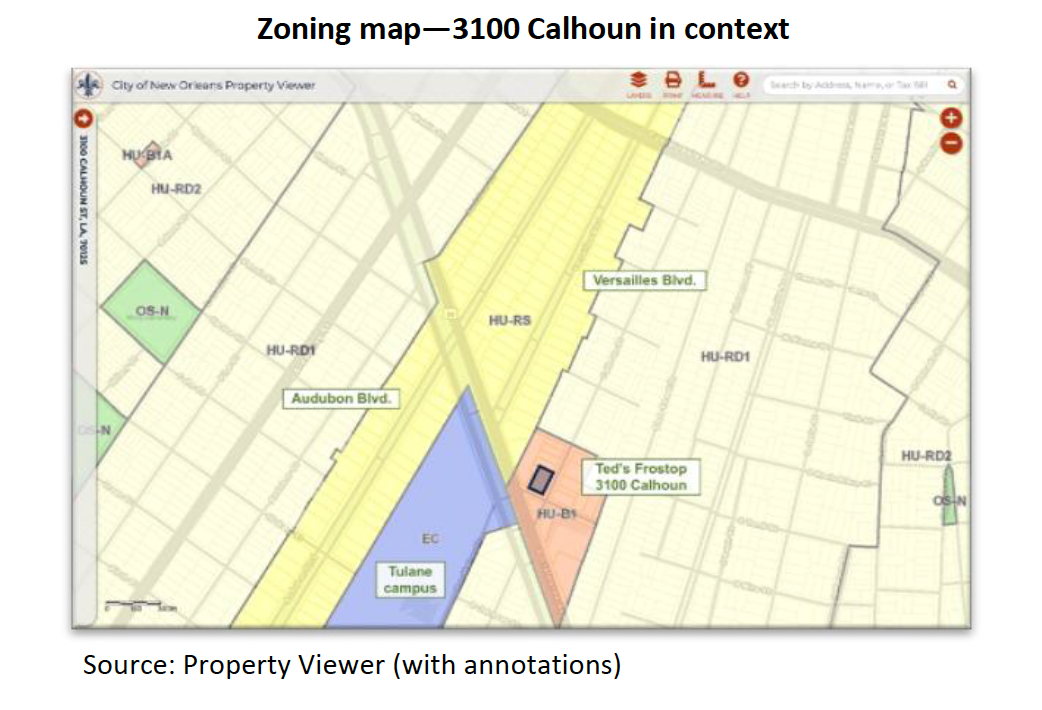
Louisiana Landmarks Society is deeply concerned that approval of this project will establish a harmful precedent in terms of massing, density, and scale — one that could invite further incompatible development in the area. Even if it were
technically compliant with zoning standards, technical compliance does not necessarily constitute compatibility with the community. The integrity of the neighborhood’s residential character must be actively protected, not merely defended from the most egregious violations.
III. Institutional Overreach: Tulane University’s Expansion Across S. Claiborne Avenue
S. Claiborne Avenue has long served as a natural and implicit boundary between Tulane’s uptown campus and adjacent residential neighborhoods. This proposed development represents the university’s first incursion across that boundary and sets a deeply troubling precedent for more institutional encroachment into residential areas.
Moreover, in pursuing an off-campus housing arrangement with a private developer, Tulane University avoids the necessity (and potential controversy) of amending its Institutional Master Plan (CZO Art. 15.5). Although Tulane has stated that it will comply with the CZO, in this case, the university seems to be evading its commitment to the laws of the City of New Orleans.
Although Tulane characterizes itself as merely a lessee of the residential portion of the development, its involvement as the primary driver of this project is evident. This is a de facto expansion of the Tulane campus footprint into a historic residential neighborhood. Louisiana Landmarks Society joins the nearby neighborhoods in firmly opposing any such expansion, however it may be structured or labeled.
IV. Parking, Traffic, and Quality of Life
The surrounding neighborhood already bears significant quality-of-life burdens from Tulane’s existing campus operations. Parking is chronically overwhelmed on game days, with students and visitors regularly occupying residential streets. The proposed development would offer only 37 parking spaces for 160 residents — a ratio that will dramatically worsen an already strained situation.
The area is also served by multiple schools, and existing school traffic already creates substantial congestion during morning and afternoon hours. Adding a large residential student population to this environment will further overtax local infrastructure. Trash management, already a concern in high-density student areas, will only be exacerbated by the increased residential density this project would introduce.
V. Pedestrian Safety on S. Claiborne Avenue
S. Claiborne Avenue is designated as U.S. Route 90 — a high-volume national highway and official hurricane evacuation route. Housing 160 students in a residence directly across this dangerous corridor from their campus will inevitably result in frequent pedestrian crossings under hazardous conditions.
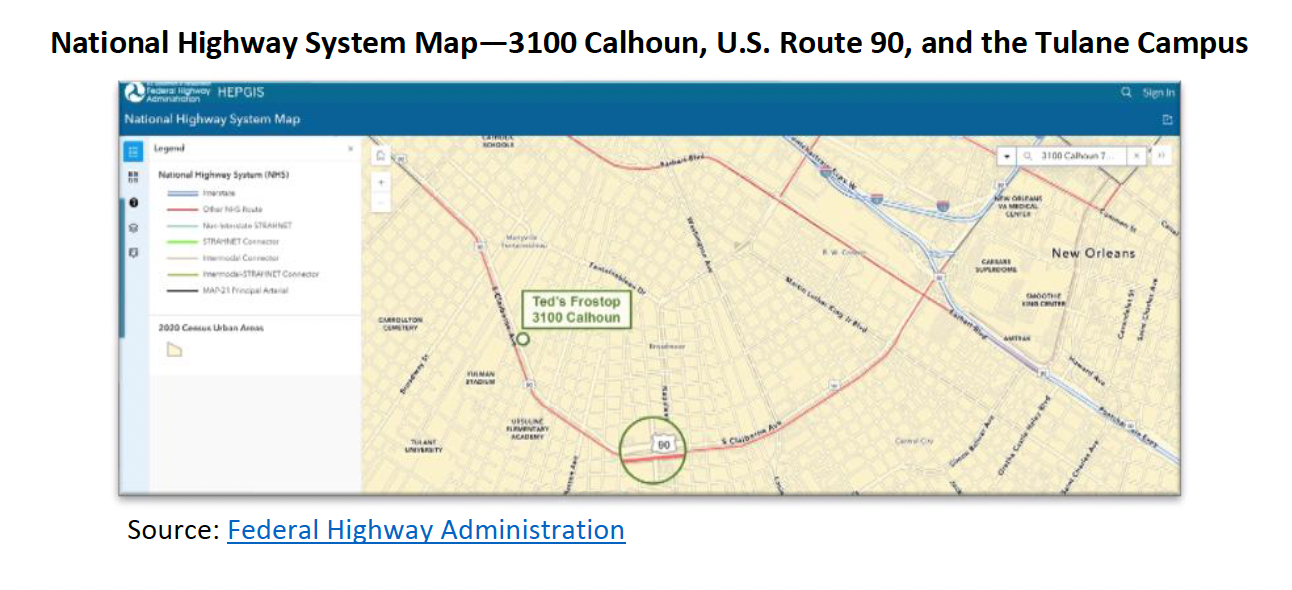
Tulane University and the developers have offered no credible plan to address the foreseeable pedestrian safety risks this siting creates. The potential for serious injury or death is not a theoretical concern — it is a predictable consequence of placing a student residential facility in this location. No community should be asked to accept that risk without a comprehensive and independently reviewed safety plan.
VI. Threatened Destruction of a Beloved Neighborhood Landmark
Ted’s Frostop is far more than a restaurant. It is a living piece of New Orleans cultural heritage — a rare and cherished functioning vestige of mid-century roadside architecture and a gathering place with deep roots in the community. The restoration of the iconic root beer mug after Hurricane Katrina made the sign a symbol of neighborhood resilience and continuity. Its loss would be irreversible. It is precisely the kind of irreplaceable establishment that defines New Orleans’ distinctive cultural character.
While we acknowledge the stated intention to preserve the “Designated Classic Sign” (CZO Art. 24.15.D), affixing a historic sign to a modern, box-like apartment complex is not preservation — it is superficial decoration. The demolition of the original structure — integral to the essence of the unique restaurant — is harmful to neighborhood character and disrespectful to the generations of New Orleanians who love Ted’s Frostop.
The developers have stated that their plan does not include off-street parking for the new Ted’s Frostop. With 160 residents already competing for only 37 on-site spaces, street parking in the surrounding area will become even more scarce. The predictable result is that customers of Ted’s Frostop will be unable to find parking — a circumstance that, regardless of the developers’ stated intentions toward the business, will hasten its decline and, ultimately, its closure.
VII. Requests
Louisiana Landmarks Society respectfully requests the following:
An immediate halt to all planning, permitting, and construction activities related to this development, pending meaningful community review.
• A formal, open community engagement process — including public meetings with adequate advance notice — in which neighborhood residents have a genuine opportunity to shape any proposal for this site.
• Consideration of all alternative sites that could provide adequate student housing, preferably on campus rather than intruding into a historic neighborhood.
• A full and independent study of traffic, parking, and pedestrian safety impacts, the results of which will be made publicly available prior to any further action.
• A redesign of any proposed project that is compatible in scale, massing, and character with the existing residential neighborhood.
• A binding public commitment from Tulane University that it will not pursue further expansion across S. Claiborne Avenue into residential neighborhoods without full community consent.
• Serious exploration of alternatives to demolition that would preserve the original Ted’s Frostop structure and its historic character.
New Orleans’ historic neighborhoods are irreplaceable. Once lost, the character, culture, and quality of life they embody cannot be restored. We urge Tulane University, RCR Claiborne Venture III, LLC, and the City of New Orleans to honor their obligations to the communities they serve — and to pursue a process worthy of the trust those communities have placed in our institutions.
Louisiana Landmarks Society stands ready to engage in good-faith dialogue — in a process that begins with transparency, genuine respect, and a sincere willingness to listen to the people who call this neighborhood home.
Respectfully submitted,
Sandra Stokes
Chair of Advocacy
Louisiana Landmarks Society
225-445-3800